How Much Mulch, Gravel, or Soil Do You Need? A Guide to Calculating Your Order
October 30, 2026
QUICK ANSWER: To find how much material you need, multiply length by width in feet to get square feet, multiply that by the depth in feet (inches divided by 12) to get cubic feet, then divide by 27 to get cubic yards. A bed 30 feet long and 8 feet wide covered 3 inches deep needs about 2.2 cubic yards of mulch. At our yard, a mulch scoop is about one cubic yard and covers roughly 120 square feet at about 3 inches deep, so most owners can check their math against that rule of thumb. Round up a little, break odd shapes into simple pieces, and remember that gravel and soil settle once they are spread and compacted.
Every spring the same thing happens at our yard. Someone pulls in with a pickup, a rough idea that the front beds are "about this big," and no idea whether they need one scoop or five. They are not alone. Estimating volume is the part of a yard project that trips up nearly everyone, because we measure ground in square feet and buy material in cubic yards.
The good news is that the math is short, and once you see it worked out a few times it becomes second nature. This guide walks through the formula, then applies it to mulch beds, tree rings, lawn leveling, raised beds, and a gravel driveway. We load and deliver across Maryville, Alcoa, Townsend, Seymour, Farragut, Sevierville, Knoxville, and the surrounding parts of East Tennessee, and these are the same examples we talk through with customers every week.
The Three Numbers Behind Every Order
Every order comes down to length, width, and depth. Length and width give you the area of the space, measured in square feet. Depth turns that flat area into a volume, which is what a truck or loader actually carries.
The catch is that depth is usually quoted in inches while length and width are in feet. Before you multiply, convert the depth to feet by dividing the inches by 12. Three inches becomes 0.25 feet. Two inches becomes about 0.17 feet. Six inches becomes 0.5 feet.
Here is the whole formula in one line: length in feet times width in feet times depth in feet, divided by 27, equals cubic yards. The 27 is there because a cubic yard is 3 feet by 3 feet by 3 feet, which holds 27 cubic feet.
That is all there is to it. Everything below is just this formula applied to different jobs.
How Our Scoops Relate to Cubic Yards
At our yard, material is sold and loaded by the scoop, so it helps to know what a scoop means. A mulch scoop is about one cubic yard. Our standard scoop covers approximately 120 square feet when spread about 3 inches deep.
If you run the pure math, one cubic yard spread 3 inches deep covers 108 square feet. Our 120 square foot rule of thumb is a little more generous because a scoop from the loader is not a perfectly measured cubic yard and mulch fluffs as it comes off the pile. Use the formula to get your number, then check it against the scoop rule. When the two agree within a few square feet, you have a solid estimate. When they differ, trust the yard's scoop guidance and ask our staff to convert your measurements.
Rock is different. A scoop of rock weighs about one ton, which is more than many pickups can safely haul. We load and weigh rock by the scoop, so for gravel and stone, think in cubic yards for the math and in scoops for the ordering, and let us translate between the two when you call.
Worked Example: A Rectangular Mulch Bed
Suppose you have a front bed that runs 30 feet along the house and is 8 feet deep. You want mulch about 3 inches deep, which is within the 2 to 3 inch range that suits most beds.
Area: 30 feet times 8 feet is 240 square feet.
Depth: 3 inches divided by 12 is 0.25 feet.
Volume: 240 times 0.25 is 60 cubic feet.
Cubic yards: 60 divided by 27 is about 2.2 cubic yards.
Check it against the scoop rule: 240 square feet divided by 120 square feet per scoop is 2 scoops. The formula says 2.2 and the rule says 2, so you are looking at two scoops, plus a small cushion if you want to top off a low corner.
Tip: Measure the bed at its widest and narrowest points and use the average if the edge is not perfectly straight. A few extra minutes with a tape measure beats a second trip to the yard.
Worked Example: Circular Beds and Tree Rings
Round shapes use the area of a circle: 3.14 times the radius squared, where the radius is half the width across.
Take a round bed 12 feet across. The radius is 6 feet, so the area is 3.14 times 36, or about 113 square feet. At 3 inches deep that is 113 times 0.25, or about 28 cubic feet, which is 1.05 cubic yards. One scoop covers it with almost nothing left over.
Tree rings work the same way, only smaller. University of Tennessee Extension advises keeping mulch to no more than about 2 to 4 inches deep, tapering out toward the edge of the ring, and applying it in a ring at least 4 to 6 feet across. Say you have six trees, each with a 6 foot ring mulched 3 inches deep. Each ring is about 28 square feet, so each needs about 7 cubic feet. Six rings need about 42 cubic feet, which is roughly 1.6 cubic yards.
Keep the mulch pulled back several inches from each trunk so the base stays exposed and air moves freely. A pile against the trunk is the wrong shape even when the volume is right.
Worked Example: Odd Shapes and Winding Beds
Real yards rarely have perfect rectangles. The trick is to break an odd bed into pieces you can measure, then add the pieces together.
Imagine an L shaped bed. One leg is 20 feet by 5 feet, which is 100 square feet. The other leg is 10 feet by 6 feet, which is 60 square feet. Together that is 160 square feet. At 3 inches deep, 160 times 0.25 is 40 cubic feet, or about 1.5 cubic yards.
For a triangle, multiply the base by the height and divide by 2. For a curved edge, picture a rectangle that roughly matches the bed and nudge your number up or down by eye. Winding beds along a fence or driveway can usually be treated as a long thin rectangle using the average width.
If your bed already has mulch on it, measure the depth you have now. When it is already about 3 inches deep or matted down, it is better to remove some before adding more than to stack a fresh layer on top. Your order should cover only the difference between what is there and the depth you want.
Worked Example: Pine Straw
Pine straw is the exception because it is sold by the roll instead of the scoop. A roll weighs about 30 pounds and covers about 160 square feet. For a hillside planting of 800 square feet, divide 800 by 160 and you get 5 rolls. There is no depth conversion to do, which makes pine straw the quickest estimate of all.
Worked Example: Topsoil for Lawn Leveling
Topsoil math looks the same, but the depths are much thinner, and that changes the answer dramatically. When you are leveling a lawn, thin layers of about a quarter to a half inch let the existing grass grow up through the soil. Larger low spots should be filled in stages.
Take a lawn that is 40 feet by 25 feet, which is 1,000 square feet, and say you plan to topdress it half an inch deep. Half an inch is about 0.042 feet. Multiply 1,000 by 0.042 and you get about 42 cubic feet, which is 1.5 cubic yards.
Now see what happens if someone mistakenly spreads 2 inches across the same lawn. That is 167 cubic feet, over 6 cubic yards, and likely a smothered lawn. The same formula gives very different answers depending on the depth, so check your inches before you check your total.
Warning: Do not bury grass under a thick layer of soil in one pass. More than about half an inch at a time can smother the turf. Spread thin layers, let the grass recover, and repeat if the low area needs more.
Worked Example: Soil for a Raised Bed
Raised beds are generally 6 to 12 inches high, with the taller end suited to deep rooted crops like tomatoes. A bed that is 4 feet wide and 8 feet long filled to 10 inches uses these numbers.
Area: 4 times 8 is 32 square feet.
Depth: 10 inches divided by 12 is about 0.83 feet.
Volume: 32 times 0.83 is about 26.7 cubic feet, which is just under 1 cubic yard.
That means one scoop of garden soil is almost exactly right for a single 4 by 8 bed at 10 inches. If you are building three beds, plan on three cubic yards and consider a mix. Our organic garden soil blends soil, compost, sand, and chicken manure, and we can mix custom blends to order, such as topsoil with compost for a lawn or a specialty mix for acid loving shrubs.
Soil in a new raised bed also settles over the first few weeks, so start a little full and top it off after the first good rain.
Worked Example: A Gravel Driveway
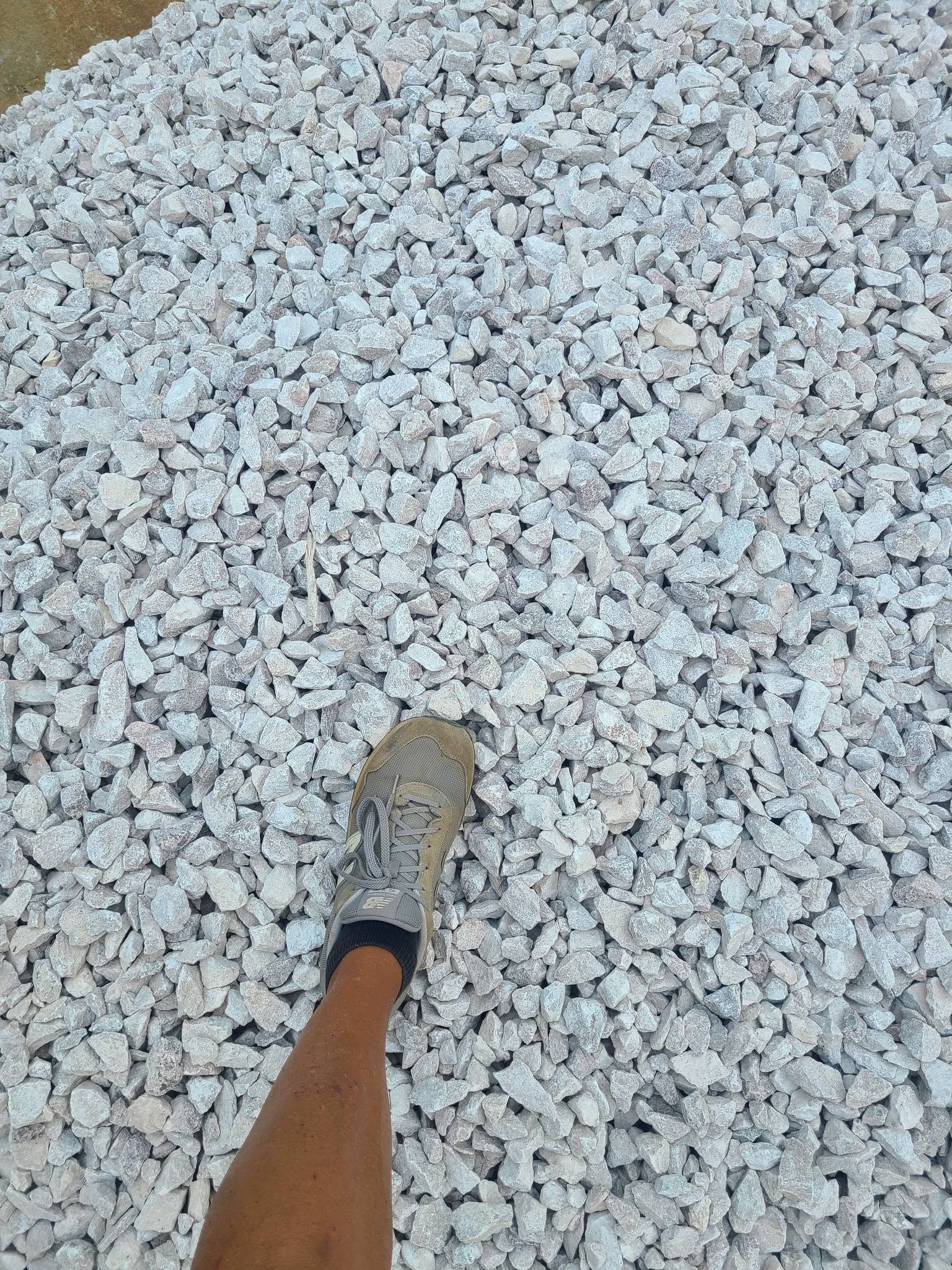
Gravel jobs are where the numbers get big, so the math matters most. A new gravel driveway is built in layers. On our site we describe a larger stone such as Gravel #4 at the bottom, with #57 or Crush & Run on top, for roughly 6 to 8 inches of total depth on a new drive. A typical split is about a 4 inch base with 2 to 4 inches of surface stone.
Consider a drive 12 feet wide and 60 feet long. The area is 12 times 60, or 720 square feet.
The 4 inch base: 720 times 0.333 is 240 cubic feet, or about 8.9 cubic yards.
A 3 inch surface layer: 720 times 0.25 is 180 cubic feet, or about 6.7 cubic yards.
Together that comes to about 15.6 cubic yards of stone for a new drive. Refreshing an existing driveway with a thin top layer takes far less. A 2 inch top dressing on the same 720 square feet needs about 4.4 cubic yards.
Because rock is heavy, the number of scoops and the weight on your truck matter as much as the volume. A full size pickup bed holds roughly 2 to 3 cubic yards by volume, but a scoop of rock weighs about a ton, so check your payload before you load stone yourself. For a big driveway, delivery is the safer plan, and Gravel #4 and RipRap Filter Stone are available by delivery only.
Tip: Stone compacts when it is rolled or driven on, so a driveway almost always takes slightly more than the loose math says. Adding about 10 percent to your gravel total is a reasonable cushion.
Common Mistakes That Throw Off Your Numbers
A few errors show up again and again, and they are all easy to avoid.
- Mixing inches and feet: Convert inches to feet before multiplying measurements to avoid incorrect volume calculations.
- Forgetting to divide by 27: Divide cubic feet by 27 to calculate cubic yards correctly.
- Using the same depth for every material: Choose material-specific depths for mulch, topdressing, raised beds, and driveways.
- Ignoring settling: Add a small extra allowance to account for material settling and compression.
- Measuring once: Measure twice and sketch the area to catch mistakes before ordering.
Getting Your Order Ready for Delivery
Once you have your cubic yard number, the rest is logistics. We deliver in single axle trucks that fit tight spots, and most orders go out within about a week, with Saturday delivery available. Schedule at least a day or two before you need the material on site.
Before the truck arrives, mark the drop spot and clear vehicles, tools, and debris from the path. Keep children and pets inside while the truck backs in. Gravel can be tailgate spread, where the truck bed opens and the truck pulls forward so the stone lays out evenly, which is useful on driveways. If heavy rain is in the forecast, we may reschedule to avoid rutting a wet yard, which is common in a region that sees about 50 inches of rain a year.
Different materials can sometimes ride together if they stay separated and within weight limits, so a mulch and topsoil job can often arrive in one trip.
Frequently Asked Questions
How many cubic yards of mulch do I need for 1,000 square feet?
At 3 inches deep, 1,000 square feet needs about 9.3 cubic yards, and at 2 inches about 6.2. Our scoop rule of 120 square feet each suggests a little over 8 scoops.
How deep should mulch be?
Most beds do well with 2 to 3 inches, and University of Tennessee Extension advises no more than about 4. Thicker layers can restrict oxygen to roots, so keep mulch several inches from trunks.
How much does a scoop cover?
A mulch scoop is about one cubic yard and covers roughly 120 square feet at about 3 inches deep. A thinner layer stretches coverage further, while a thicker layer covers less ground.
How do I figure out how much gravel I need?
Multiply length by width by depth in feet, then divide by 27. For driveways, calculate the base and surface layers separately and add them. Add 10 percent for compaction and ask our staff for scoops.
Can I haul a scoop of rock in my pickup?
Probably not safely. A scoop of rock weighs about one ton, while a full size pickup bed holds 2 to 3 cubic yards, so weight is the limit. Check your payload or choose delivery.
Does the amount change for clay soil?
The volume math stays the same, but base layers change. Where red clay is common, as in Blount and Knox counties, use a thicker coarse stone base under driveways and add compost to topsoil.
Measure Once, Calculate Carefully, and Order With Confidence
Estimating material comes down to three simple numbers and one reliable formula. Once you convert depth from inches to feet, multiply it across the area, and divide by 27, the guesswork disappears from every project. Whether you are refreshing a mulch bed, topdressing a lawn, filling a raised bed, or building a gravel drive, the same steps apply. A small cushion for settling and compaction keeps you covered, and a quick sketch of the shape catches most mistakes early.
Out of Eden Bulk Landscape Material
has
supplied mulch, gravel, soil, and stone
to homeowners, contractors, and landscapers in Maryville, TN, for over 25
years in business, and the questions we hear most often come back to these same calculations. Planning your order carefully means the right amount arrives at the right spot, with little left over and nothing missing. Good measurements, honest depths, and a modest buffer turn a stressful estimate into a straightforward plan that your yard will reward all season.